We use cookies to make your experience better. To comply with the new e-Privacy directive, we need to ask for your consent to set the cookies. Learn more.

INVENTO EL 250 TL - 5 T - Two-post lift
Promo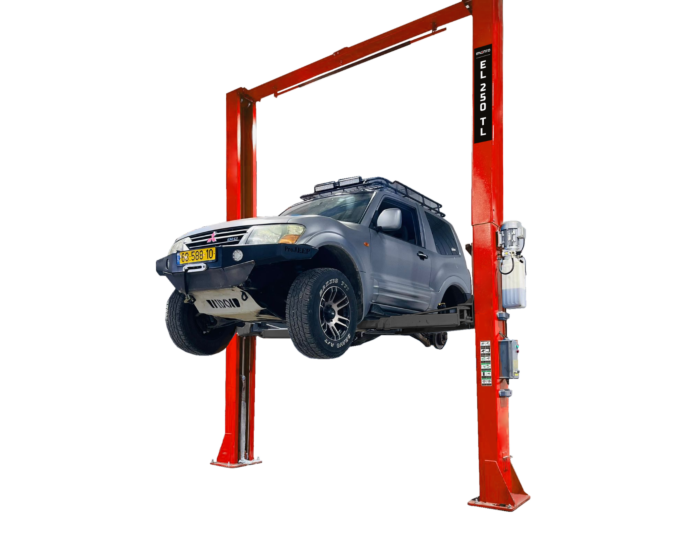
Product category: 2- post lifts
Index
INVEL250TL
Not available
Available from: 01-11-2026
Available from: 04-11-2026
Available from: 25-11-2026
Price for: 1 PC.
INVENTO EL 250 TL is a fully automatic, hydraulic lift with top column connection with a lifting capacity of 5 tons.
Details
Technical data
Accessories
Warranty
Safety
- Details
-
INVENTO 250 TL two - post lift is an electro-hydraulic lift connected at the top at a height of 5.1 m. The length of the arms and the 5-ton lifting capacity enable the handling of passenger cars, SUVs and high delivery vehicles.
Free access to wheels and chassis makes it a universal tool for work in the workshop.
Key information about the lift:
- large arm range (3-stage)
- automatic pawls keep the lift in a safe position during operation
- movement synchronization via a steel cable passing through the upper connection
- upper protection against damage to the car roof
- has special extensions to facilitate the operation of delivery vehicles
The INVENTO EL 250 TL lift is equipped with the necessary safeguards required by CE documentation. This guarantees long and safe work in the workshop.
The lift has been designed for installation in covered, closed rooms without obstacles. Operating temperature ranges from -10°C to 40°C.
Installation requirements:- Concrete class C25/30 with a thickness of min. 200mm
- Mounting area: 1.5 m from the anchor point
- The floor is unscratched and level
- Technical data
-
Capacity 5 000 kg Max lifting height 1 900 mm Min lifting height 105 mm Arm length 800 - 1 500 / 1000 - 1 950 mm Lift height 5 100 mm Width between columns 3 342 mm Total width 4 136 mm Weight 1 020 kg Power supply 400V/50 Hz Engine 2,2 kW - Accessories
- Warranty
-
Warranty: 12 months
- Safety
-
- Responsible Producer:
-
TIPTOPOL SP. Z O.O.
ul. Kostrzyńska 33
62-010 Pobiedziska
Poland
sklep@tiptopol.pl
+48618152200
Electrical risks
The product is powered by electricity and a variety of electrical hazards may occur during operation, which can lead to serious consequences.
Short circuit: This can lead to power outages, damage to equipment, and fire hazards.
Explosions and fires: Improper use of electrical products, such as the use of improper or no safety features, can lead to sparks that start fires. They can cause damage to property and a threat to life and health.
Electric shock: This can lead to personal injury and, in extreme cases, death.
Insulation defects: Poorly insulated wires can lead to an uncontrolled flow of current that can pose a risk to users. This can lead to electric shock, damage to equipment and fires.
Poor grounding: Lack or improper grounding of electrical appliances can cause a buildup of electrical charge. Doing so may lead to electric shock and damage to appliances.
To minimize these risks, it is recommended that the equipment be installed by authorized persons, that electrical installations are regularly inspected, that appropriate safeguards are in place, and that the manufacturer's recommendations for the safe use of the equipment are followed.
Mechanical risks
The product has movable parts that can cause a variety of mechanical hazards during operation, which can lead to serious injuries.
Crushing and crushing: There is a risk that the moving parts of the product will crush or crush the body. It can lead to serious injury or permanent injury.
Cuts and punctures: Cuts, cuts, and even deeper injuries can occur if the user comes into contact with sharp edges or product components.
Impact and Fall Injuries: These can occur when objects fall over and fall from a height or are moved in an improper and dangerous manner. This can cause serious injuries, including broken bones and head injuries.
Trapping: If a body part becomes trapped between moving parts, it can lead to serious injury and loss of limbs.
Vibration: Exposure to prolonged vibration while using the device can damage muscles and nerves. This can lead to vibration syndrome, causing pain and dysfunction in the limbs.
To minimise these risks, it is recommended to use appropriate personal protective equipment, regularly inspect and maintain the equipment, and follow all manufacturer's recommendations for safe use and health and safety (Occupational Health and Safety) regulations.
Files to download
